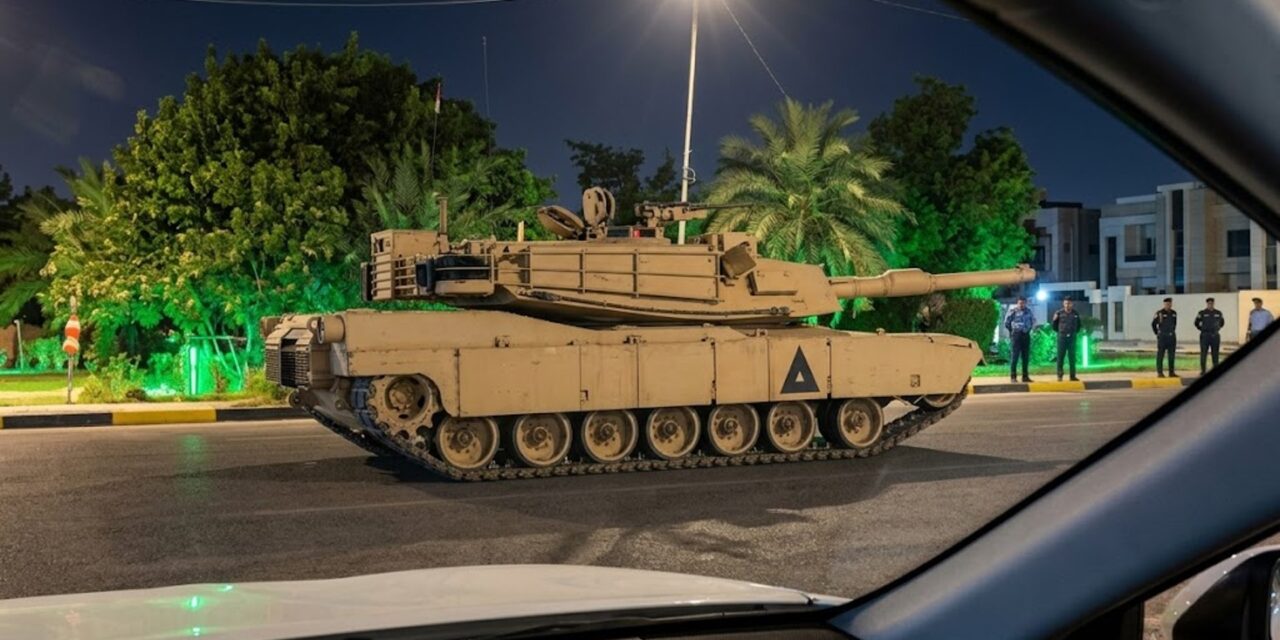
(Photo: A tank deployed to the Green Zone during the anti-corruption raid. +964 Media)
The Iraqi government’s recent anti-corruption campaign has won rare praise from many Iraqis and Iraq watchers. Beginning on June 28, security forces carried out coordinated raids across Baghdad and several provinces, arresting dozens of current and former officials on corruption charges. Among those detained were lawmakers, deputy ministers, former governors, and senior officials from the Ministry of Oil. Prime Minister Ali Al-Zaidi has described the campaign as the beginning of a sustained effort to recover stolen public funds and vowed that “no corrupt official” will be immune from prosecution.
The scale of the operation is significant. Few Iraqi governments have pursued such a broad sweep against sitting officials. Yet despite widespread public support, the campaign has also been met with deep skepticism. That skepticism does not necessarily stem from doubts that those arrested engaged in corruption. Rather, it reflects a long history of selective enforcement, institutional weakness, and political interference that has repeatedly undermined anti-corruption efforts in Iraq.
To understand why many Iraqis remain cautious, it is necessary to look beyond the latest arrests and examine the structural nature of corruption in the country.
Last year, Iraq ranked 136th on Transparency International’s Corruption Perceptions Index. While Iraq has now elected its eighth government since 2003, the underlying system that enables corruption has changed remarkably little. Corruption remains entrenched throughout the state, and its single greatest enabler continues to be Iraq’s post-2003 power-sharing arrangement, commonly known as muhasasa.
Designed to prevent the reemergence of dictatorship, muhasasa instead breeds corruption because it produces governments with weak accountability, whether to the prime minister or the public. Instead of merit, partisan and sectarian quotas are used to divide senior government positions and ministries. Once a political group gains control of a government agency, it exploits its position to build and maintain patronage networks through which it can reward supporters and finance political activities. Since all participating parties benefit from this system, they are often reluctant to investigate one another, making accountability selective.
This system produces corruption at multiple levels. At the top, ministries often function as political fiefdoms. Ministers, directors general, and department heads control procurement contracts, hiring, licensing, and spending decisions that benefit party leaders and their allies. At the middle level, legitimate businesses frequently encounter extortion and unfair competition from politically connected companies that use their influence to dominate entire sectors of the economy. At the bottom, ordinary Iraqis continue to face petty bribery when seeking basic public services.
Another factor complicating anti-corruption efforts is the social environment in which they occur. Iraqi society places considerable importance on family, tribal, and kinship obligations. Helping relatives secure employment or business opportunities is often viewed as fulfilling social responsibilities rather than engaging in corruption. When these practices become widespread, refusing to participate can carry personal and professional costs. Individuals who decline to use connections may find themselves disadvantaged compared with those who do.
These social expectations do not excuse corruption, but they help explain why patronage networks remain resilient even when their economic costs are widely recognized. Corruption therefore is not simply the product of dishonest individuals. It has become embedded within the incentives that govern political competition and public administration.
The so-called “Heist of the Century” remains perhaps the clearest illustration of how resilient this system has become. Over roughly a year, nearly $2.5 billion was siphoned from the Iraqi Tax Commission through hundreds of fraudulent checks cashed by shell companies before a whistleblower exposed the scheme. Yet the government’s response raised almost as many questions as the theft itself.
The principal suspect was released on bail after receiving assurances that the stolen funds would be returned, only to leave the country before eventually being sentenced to prison in absentia. Years later, only a small fraction of the stolen money has reportedly been recovered.
Even more revealing was the institutional response. Senior officials within the Integrity Commission and members of the judiciary publicly accused one another of concealing evidence, obstructing investigations, and shielding suspects. Despite these extraordinary allegations between two of Iraq’s principal oversight institutions, neither side faced meaningful investigation or accountability. Instead of reinforcing public confidence, the episode exposed institutions that appeared unable or unwilling to police themselves.
This pattern extends well beyond the tax theft. Several years ago, a prominent Iraqi politician openly acknowledged accepting bribes during a televised interview. Yet legal action only came much later, after his political influence had declined and he clashed with more powerful actors. Similarly, the recent arrest of a former head of Iraq’s North Refineries Company raises legitimate questions about selective enforcement. Why prosecute one official today while powerful actors connected to the systematic looting of the Baiji refinery after ISIS’s capture of the facility remain beyond the reach of investigators?
This pattern has persisted across successive governments. The problem is not simply that too few corrupt officials are prosecuted. It is that prosecutions often appear to target those who have lost political protection while leaving more powerful networks untouched. The latest anti-corruption campaign inevitably raises similar questions.
Among those arrested are senior officials from the Ministry of Oil, lawmakers, former governors, and influential political figures. Yet thus far, none of the detainees appear to have direct ties to Iraq’s most powerful Iran-backed armed groups, many of which possess substantial political influence and extensive economic interests. Whether this reflects evidentiary realities or political constraints remains unclear, but the absence has not gone unnoticed.
At the same time, the campaign should not be dismissed outright as merely another political purge. Iraq’s government currently faces severe fiscal pressures after the recent Iran war disrupted oil exports through the Strait of Hormuz, exposing the country’s overwhelming dependence on petroleum revenues. Recovering stolen assets therefore serves an immediate financial purpose. The campaign also strengthens Prime Minister Zaidi’s reform credentials at a time when his government is seeking to reassure international investors and deepen engagement with Washington.
These motivations are not mutually exclusive. A campaign can simultaneously recover public funds, consolidate political authority, and prosecute genuinely corrupt officials. The challenge lies in determining whether enforcement will eventually extend beyond politically vulnerable figures. Moreover, Iraq’s corruption problem cannot be solved solely through arrests.
A government composed of political actors whose influence depends upon patronage faces inherent limitations in dismantling the very system that sustains it. History offers numerous examples of reform initiatives that lost momentum once they threatened entrenched interests. Former Prime Minister Haider Al-Abadi’s effort to audit payrolls within the Popular Mobilization Forces ended after the auditor assisting the process was assassinated, sending a powerful message about the risks associated with challenging established networks.
Recent cabinet appointments also offer mixed signals. Ministries such as Electricity, Oil, and Communications remain among the government’s largest focal points of revenue, procurement spending, and political patronage. As long as control over these and similar institutions continues to serve as a central objective of actors with close ties to armed networks and family involvement in major energy contracts, the outlook appears to offer continuity, not reform.
The current campaign therefore deserves careful attention, but also realistic expectations. If it continues to expand regardless of political affiliation, successfully recovers substantial public assets, and is accompanied by sustained efforts to empower oversight institutions and greater judicial independence, it could represent an important first step toward greater accountability.
If, however, it ultimately proves limited to politically expendable figures while leaving Iraq’s most powerful patronage networks untouched, it will reinforce a familiar lesson from the country’s post-2003 experience: anti-corruption campaigns are often easier to launch than to sustain, and far easier to use as instruments of political competition than as vehicles for genuine institutional reform.
The coming months will therefore be more important than the dramatic arrests that launched this campaign. The central question is no longer whether Iraq can arrest corrupt officials. It is whether the country’s political system is finally prepared to confront the structural incentives that have allowed corruption to flourish for more than two decades.

Omar Al-Nidawi
Omar Al-Nidawi is the director of programs at the Enabling Peace in Iraq Center and a nonresident senior fellow with the Iraq Initiative in the Atlantic Council’s Middle East programs.

Trackbacks/Pingbacks