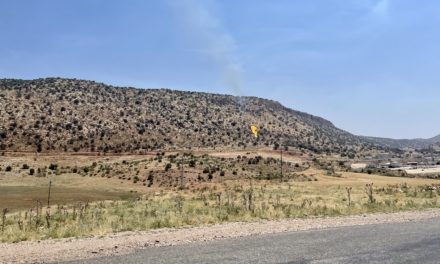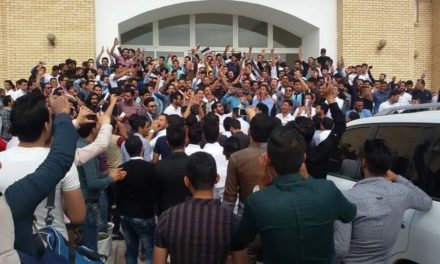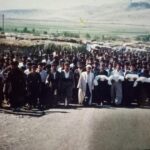
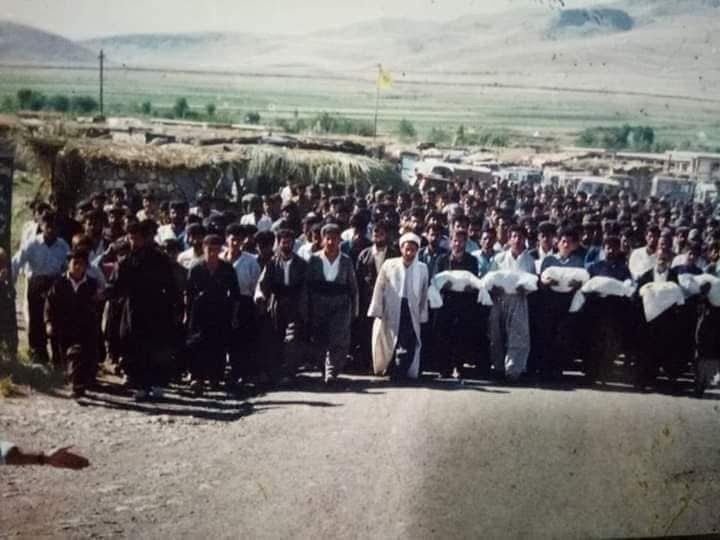
(The burial ceremony of 26 Hawraman residents who were buried alive on May 13, 1987. Their remains later discovered in a mass grave in 1995. Photo: Sabah Hamakhan)
My father vanished on a Tuesday morning in May 1987, swallowed by a state machinery that had perfected the art of disappearance. I was one-year old, too young to hold the image of his face, but old enough for his absence to become the primary architecture of my life. For decades, he was not a man, but a shape pressed into the silence of our home, a void where a father should have been.
He was fifty years old, a son of the rugged Hawraman region, now part of Halabja province in Iraqi Kurdistan. On May 13, 1987, the thirteenth day of Ramadan, he was intercepted near Grdigo on the Hawraman–Sulaymaniyah road. Along with twenty-five other civilian men, he was erased from the official record. The Ba’athist regime produced no arrest warrants, no death certificates, no notifications. The objective was total erasure: to kill so completely that the families left behind would possess no body to wash, no grave to visit, and no proof their loved ones had ever drawn breath.
This was not improvisation. The Anfal campaign (1986–1988), eight military offensives against Kurdish civilians in Iraq, produced an estimated 182,000 deaths and the destruction of roughly 4,000 villages. The Grdigo 26 were among its countless smaller, unrecorded operations: civilians taken without paperwork so that paperwork could never indict anyone.
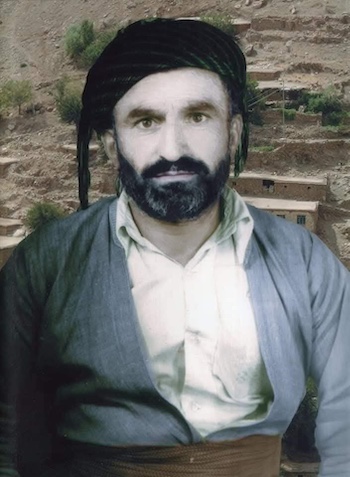
(Photo: Haji Yaseen Zellmi/1936-1987)
The Only Image
Among our few possessions is a single, weathered photograph, the only visual evidence that my father ever walked this earth. He wears the traditional Kurdish Kawa u Pantol, the fabric looking as sturdy as the hills behind him. His face carries the quiet dignity of a man from the mountains, slightly weary from raising seven children in a land under siege. It is a face that does not know it is about to be stolen. I have spent a lifetime staring into that frozen gaze, trying to find a reflection of myself, trying to memorize the father I never got to touch.
To reconstruct the crime that took him, I turned to what I call “living archives”, the accounts of those who shared his final hours. Dr. Razwan Yalanpei, a researcher at Halabja University, spent years gathering survivor testimony, producing the painstaking record preserved in his book Khurmal in the Heart of Pain and Suffering. His work represents the kind of community-driven documentation that states are supposed to perform and that the Kurdistan Genocide National Archive has been working to fill because the Iraqi state never produced one.
The mechanics of the ambush near Grdigo were brutal. Azad Mela Khalid, who witnessed the trap snap shut, recalls soldiers forcing four men from his car into a military truck: “That very night, their blood was spilled into the dirt”. My father was taken to military barracks at Haji Namiq village, near Said Sadiq, where twenty-six men were forced onto their knees, hands bound behind their backs.
What happened next carried particular moral weight. It was Ramadan. When guards brought military food into the room, the men refused it. Witness Taha Hamid Beg recalls their resolve: “We will not break our fast until we are free”. They went to the trenches of Shanadari village with empty stomachs, choosing a final fast over the bread of their executioners.
Eight Years Underground
The investigation into the Grdigo 26 remained frozen until the spring of 1995, when a farmer digging for water in Shanadari struck a mass grave. Gali Kurdistan Radio began reading the names of the twenty-six men on air. I was in the fourth grade of primary school. When the broadcaster reached my father’s name, the first on the list, the air in our small room in the Baramawa refugee camp collapsed into grief. The “disappeared” had become the “martyred”. We began three days of condolence: a ritual of mourning denied to us for eight long years.
During those three days, life in the camp demanded a cruel persistence. I was assigned a homework task for my Farsi class: write an essay about your father. I sat with my paper, the pen heavy in my hand, knowing nothing but the salt of my own tears. When my classmates told the teacher, a Kurdish man from Mariwan what had happened, the classroom transformed. He sat and cried with me. He gave me full marks: not for the words I wrote, but for the story I was forced to live.
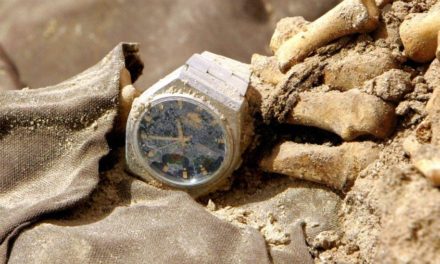
The forensic detail that stays with me is this: among the remains, several of the victims’ wristwatches were still running. They had spent eight years underground, ticking in lightless soil, keeping perfect time long after the hearts of the men wearing them had been silenced. For our family, those watches were a strange mercy, the first fixed fact in a story that the state had tried to make unfixable.
The Refugee Camp and the Spindle
While the earth was settling over my father, my mother was engineering our survival. She crossed into Iran carrying seven children, settling in the Baramawa refugee camp in the Mariwan District. There, the Ba’ath regime’s secondary objective, cultural erasure, came close to succeeding by other means: my Kurdish began to atrophy, displaced by the Farsi of the schoolroom.
My mother’s (a Hawrami women) response was a wooden spindle. When the camp school announced it would no longer provide free textbooks, she borrowed money to pay for ours, then, unable to live with the debt, spent two consecutive nights in the dark performing Tashî Rêsan, the ancient Kurdish art of twisting raw wool into thread. The rhythmic whirr of that spindle was her counter-offensive. She was spinning a future out of the wreckage of a massacre.
She passed away on May 21, 2024. Her hands, which once carried the memory of the spindle, are now at rest. What she taught me by example, never by lecture, is that what has been violently taken can be turned in the hands and fashioned into something that endures.
A Trial in Baghdad and What It Reveals
In May 2026, the Rusafa Court of Appeals in Baghdad convened a hearing that forced the question of accountability into the open. Survivors of the Anfal campaign sat facing one of their accused executioners: Ajaj Ahmad Hardan al-Tikriti, a former Ba’athist officer charged with torture, rape, and murder at Nugra Salman prison. Words of one survivor framed the day precisely: “For eight months I hid from Ajaj in Nugra Salman prison. Today he hides from us”.
The twenty-six men of Grdigo have no such trial. No Iraqi court has ever prosecuted anyone for what happened on that road on May 13, 1987. The Ba’ath regime’s strategy of producing no paperwork was, among other things, a legal strategy: without records, the evidentiary burden on any future prosecutor becomes nearly impossible to meet. The Ajaj case matters precisely because it demonstrates what accountability can look like and by contrast, makes visible how many cases were designed never to reach a courtroom.
The Iraqi High Tribunal officially recognized the Anfal campaign as genocide in 2007, issuing arrest warrants for 460 individuals. Yet many perpetrators remain unpunished, DNA identification of mass grave remains drags on for years, and Article 132 of the Iraqi constitution mandating compensation for victims of the former regime has never been fully implemented. Martyr families in the Kurdistan region receive lower financial support than their counterparts in the rest of Iraq. Kurdish collaborators who worked with the Ba’ath regime have, according to lawmakers, received better pension payments and protections than victims’ families. Transitional justice, as a framework, requires acknowledgment, reparations, and institutional reform. In Iraq, the first has been formally declared; the second and third remain largely aspirational.
Memory Without a Curriculum
In the absence of a functioning accountability system, communities have built their own infrastructure of remembrance. Across the Kurdistan region, annual commemorations mark the anniversary of the Anfal: students and teachers stand in silence in schools, universities, and public squares; families gather at monuments and graves. These are not state-organized events. They persist because grief, when it has no institutional channel, becomes ceremony.
On the Mustafa Zalmi Road in Khurmal, a monument bears twenty-six names. My father’s is first. Every year there is a memorial gathering. People come, speak the names aloud, and refuse to let the earth go quiet.
What is notably absent is a school curriculum. There is no mandatory teaching of the Anfal in Kurdish classrooms. As the generation of direct survivors ages and young Kurds grow up at a greater remove from 1987 and 1988, the specific texture of what was done, the mechanics, the names, the choices made under duress, which risks dissolving into vague collective trauma. A monument is not a lesson plan. Researchers like Yalanpei are performing the documentation work that states are supposed to do, which is to build the evidentiary base that justice requires and the narrative base that memory requires. Both are necessary. Neither alone is sufficient.
What Safe Would Look Like
The question that frames these thirty-nine years is direct: what would Iraqi Kurds need in order to feel genuinely safe again? The answer is not rhetorical. It has specific components: the Iraqi constitution must function as a genuine guarantee of Kurdish rights, not a text that is formally adopted and structurally ignored; martyrs’ family compensation must be equalized across the country; perpetrators who remain unpunished must face the same legal processes now being applied to Ajaj al-Tikriti; and the Anfal must become part of what Iraqi children are taught in school, not as Kurdish grievance, but as documented historical fact.
The watches found in the Shanadari mass grave kept running for eight years underground. That is not a metaphor. It is evidence that the mechanisms of memory are more durable than the regimes that try to stop them. The question is whether the institutions of justice can prove equally persistent.
Momen Zellmi
Dr. Momen Zellmi holds a PhD in Language Education Policy and an MA in English Language and Literature. He is a researcher at the Center for Future Studies (CFS) and a lecturer at Halabja University and Cihan University in Iraqi Kurdistan and has published numerous works in the fields of politics, language and educational policy, gender, and culture.