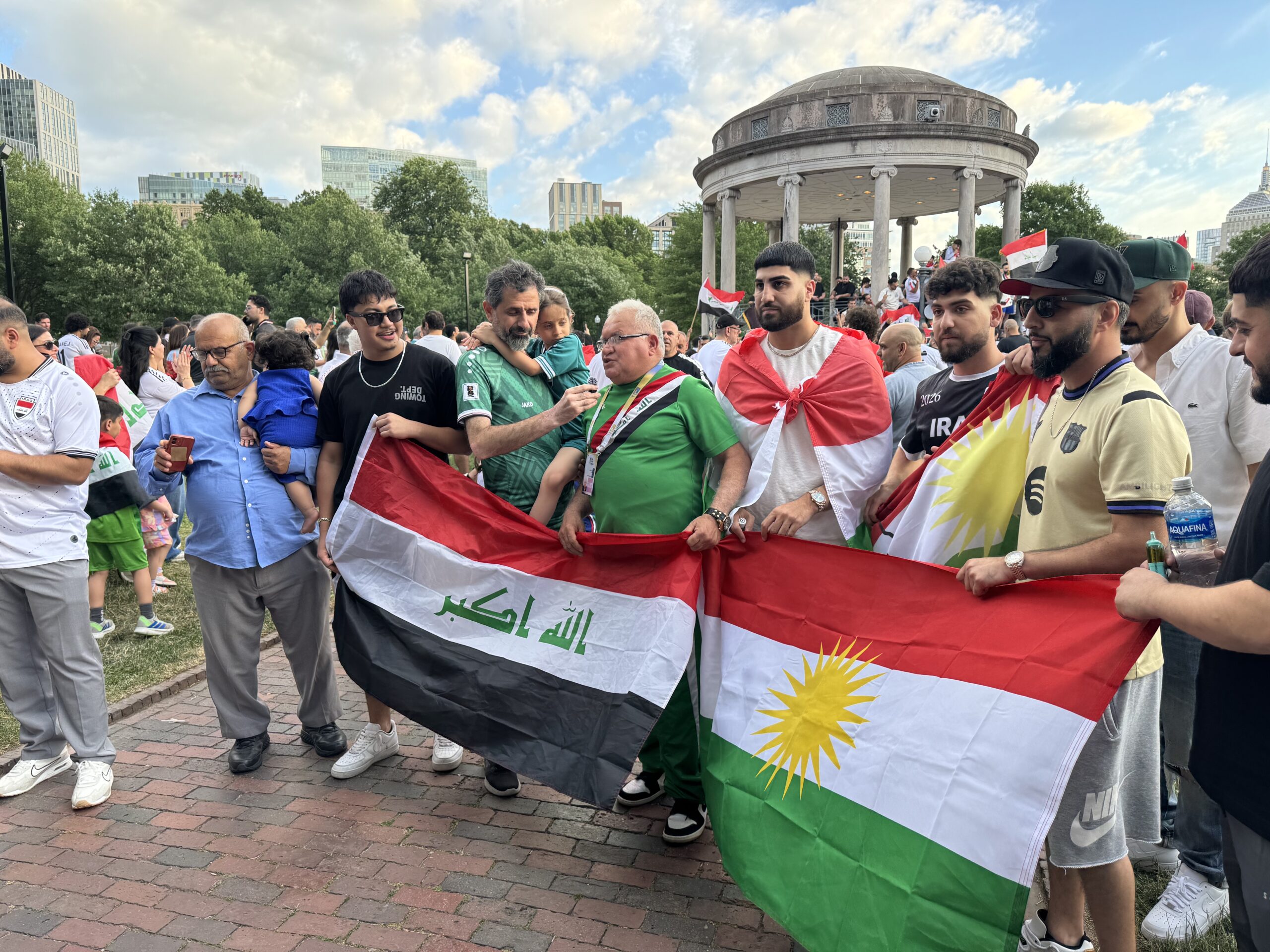
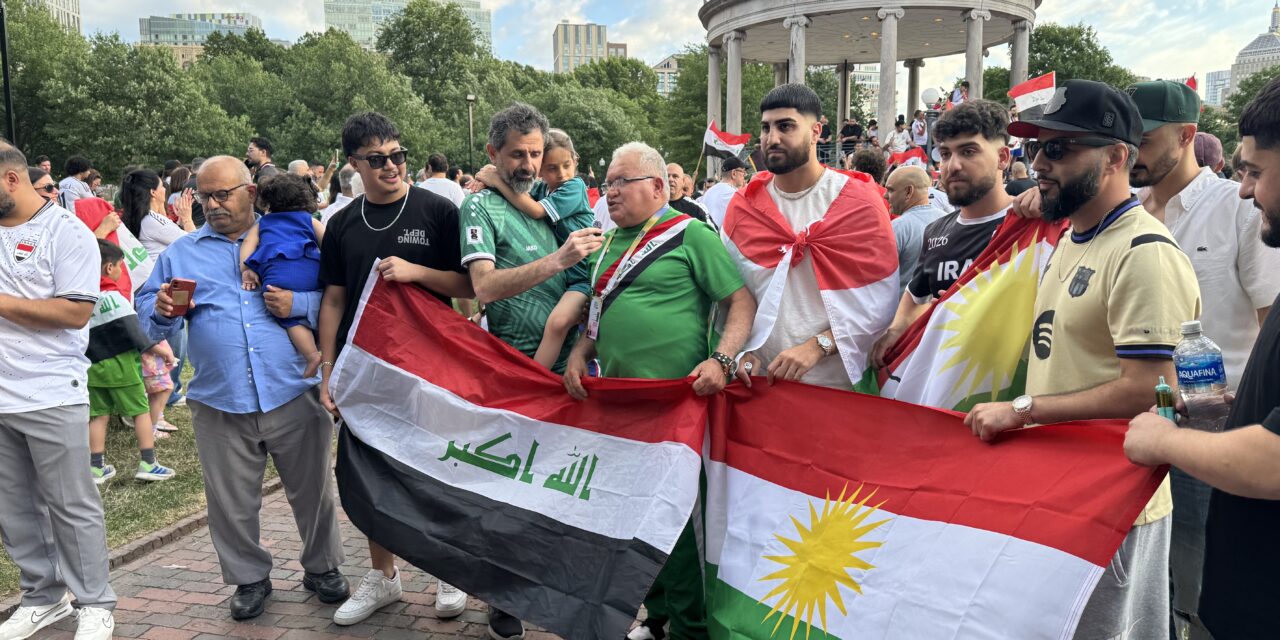
(Photo: Iraqi fans rally together in Boston Common prior to the match)
This year, the Iraqi national team qualified for the FIFA World Cup for only the second time in the nation’s history. This was a momentous event for the football-loving country as the last time they had qualified was forty years ago, during the Iran-Iraq War. This recent qualification campaign was also the first time after 2003 that Iraq could play all its home matches on Iraqi soil. During the 2014 and 2018 qualification campaigns, a few matches were played in Erbil or Basra, but the majority were played abroad and ended in failure. This latest campaign was different because Iraqi fans from across the country could come together in a show of unity, propelling the national team to the world stage.
As luck would have it, after qualifying, Iraq was placed in the so-called “group of death” which consisted of France, Senegal, and Norway. France, ranked third in the world, is both a favourite to win the World Cup and the runner up at the 2022 World Cup in Qatar. Senegal, ranked fifteenth globally, are the 2025 Africa Cup of Nations champions and Norway, though ranked thirty-first, are led by the formidable Erling Haaland, the 2026 English Premier League’s golden boot winner. Despite the ambitions of some Iraqi fans, it was never an easy task, especially as Iraq was ranked fifty-seventh globally. Added to this is the recent instability of the Iraqi Football Association, which underwent leadership change only two days after the national team began their World Cup training camp in Spain.
Logistical challenges and political obstacles are nothing new for Iraqi football. In fact, many of Iraq’s achievements have come despite the hurdles its players have had to overcome. In 2007, the now immortalized national team won the Asian Cup amidst a sectarian civil war and terrorist attacks, bringing the country together in a moment of much-needed unity. This time around, many players were held up for questioning at O’Hare Airport in Chicago, including leading striker Aymen Hussein, who was detained the longest for around seven hours and national team photographer Talal Salah, who was denied entry.
Despite this, Iraq showed up for its first match at Boston Stadium, playing attacking football and giving Norway a run for its money. Iraq pressed for much of the match and, at one point, evened the scoreline thanks to a wonderful header from none other than Aymen Hussein. The goal, Iraq’s second only goal at a World Cup, brought euphoria to Iraqis. Unlike the late Ahmed Radhi’s goal in the 1986 World Cup, this one did not come as a consolation prize, but a more meaningful goal that brought over 46 million Iraqis up on their feet.
Iraq would ultimately lose the match 4-1 due to defensive mistakes and a last-second goal, making the scoreline unreflective of the effort. This did not deter Iraqi fans from celebrating the accomplishment of qualification and scoring in a World Cup. This enthusiasm continued into the second match played in Philadelphia against France. After losing by only 3 goals to the favourites, Iraqis showed up in bigger numbers in Toronto for the third and final group stage match against Senegal. The massive crowd, dominated primarily by expats, gave the Canadian city its largest march towards Toronto Stadium. An early red card would incapacitate the Iraqi team, leaving it unable to keep up with the defending African champions, leading to Iraq’s elimination. Despite the loss, the spirit of Iraqi fans could not be dampened and the scenes in Boston, Philadelphia and Toronto demonstrate what happens when Iraqis have a shared goal and a collective sense of responsibility.
Both the players and the fans, who come from different religious and ethnic groups, celebrated the World Cup with various flags, representing the different communities in Iraq. Although the dominant flag at the celebrations was the Iraqi national flag, Kurdish and Assyrian fans raised their own flags as well. Despite the negative chatter on social media about the multiple flags, this is a normal practice in diverse federal states. When Spain won the 2010 World Cup, for example, Catalonian players raised the flag of their region while wearing the Spanish national jersey. It is no different for a Kurdish fan or player to do the same with their own constitutionally recognized region within Iraq.
It is also normal when smaller populations take pride in being overrepresented on a national team due to their skills. Assyrians, who make up around one percent of the population, are naturally proud when four of the 26 players chosen for the World Cup squad are Assyrian. A similar scenario played out in Canadian hockey last year during the 4 Nations Face-Off. In a sea of red Canada Jerseys, the Nova Scotian flag dominated the stands, simply because the captain and two other players hailed from this province, the second smallest in Canada. Despite being a federal country with one of the most unifying symbols and flags, the maple leaf, smaller provinces like Nova Scotia or more distinct provinces like Quebec will still display their provincial flags and symbols.
Going back to Iraq, non-Arab players and fans joined their Arab countrymen and women because of a shared goal (making the World Cup) and with a shared sense of responsibility (cheering on the national team). Is this any different from how Iraqis came together to defeat ISIS a decade ago? We have witnessed a lot of superficial claims, whether on social media or from politicians, that Iraqis lack a shared symbol to unite around. But, is one symbol really that important when Iraqis are able to respect each other’s diverse symbols and flags and unite around their shared goals and pride in the national team?
Raising the national flag does not make you a law-abiding citizen. In fact, in the case of many politicians, it is a drape to hide their corruption under, rather than showcase their public service and patriotism. It is the shared actions that will strengthen citizenship in Iraq and help unify its diverse components, while allowing them to continue to celebrate their distinctness.
Football is not the only thing that brings Iraqis together, it just happens to be one of the few fields in which Iraqis have a shared vision and a shared sense of responsibility. Not to mention, it is built on meritocracy and not identity. The skills of the players are what drives their success, and that success is what allows communities to celebrate their background, just like there was a shared vision in defeating ISIS and a shared sense of responsibility in ensuring Iraqi territory was free. Iraq needs more causes to rally around the flag(s). Once we achieve equality amongst all citizens and equal opportunity for everyone, then we can enter the discussion about shared symbolism that would help represent this achievement, because putting the cart before the horse will only mean these symbols represent failure. Even with the most unifying symbols in the most ideal circumstances, people want to celebrate their local and distinct identity, and having the freedom to do that is a beautiful thing.

Hamzeh Hadad
Hamzeh Hadad is an adjunct fellow at the Center for a New American Security.