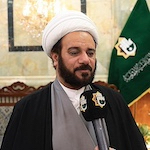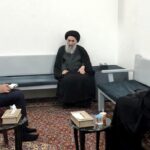
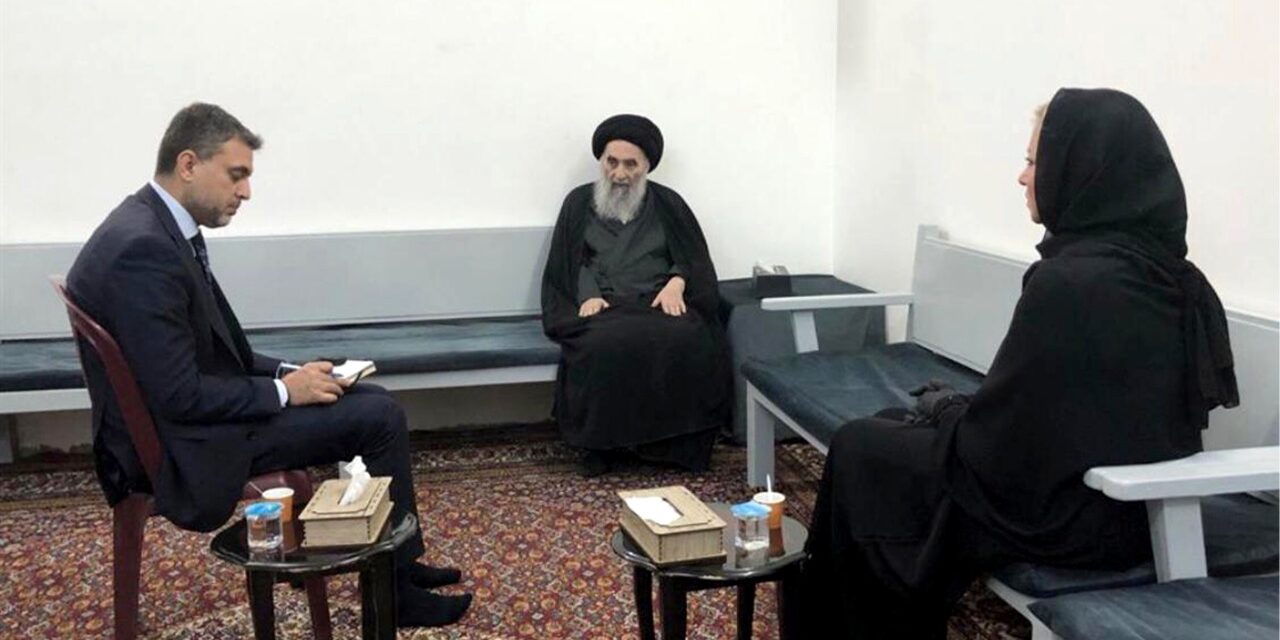
(Photo: UNAMI/Office of Grand Ayatollah Sistani)
In a time of violent escalation and the reduction of international law to mere slogans, the statement of the Shia religious establishment, issued by the office of Grand Ayatollah Ali al-Sistani, stands out. The statement takes on an explicit moral and legal stance in condemning the joint American-Israeli aggression against the Islamic Republic of Iran, offering a humanitarian plea in the face of a logic of power and dominance.
The Marjayya’s statement, issued on March 4, 2026, which deals with continued American and Israeli aggression against the Islamic Republic of Iran through military operations, is particularly important from the perspective of international law. The statement presents a clear legal and ethical approach to the use of armed force outside of the framework established by international law.
The statement clearly defines the military action as “aggression”. It is not only a definition with political implications, but one based on established concepts in public international law. It rejects the use of force against a sovereign state or its territorial integrity, which it views as a violation of the principle of the prohibition of the use of force in international relations. This definition eliminates any legal basis for widening military operations on the basis of defensive or preemptive action.
From the humanitarian perspective, the statement then draws attention to the civilian casualties, particularly children, in addition to the destruction of public and private property. This emphasis serves as a direct reminder of the obligations relevant under international law, particularly the distinction between civilians and combatants, the principle of proportionality, and the prohibition of indiscriminate targeting. This opens the door to accountability for targeting civilian areas.
The statement clearly highlights the problem of deciding to go to war outside of the framework of the UN security council. This directly undermines collective security, which is based on limiting the legitimate use of force to specialized international institutions. The violation of this framework does not threaten a specific state but rather undermines the foundations of the international order and legitimizes unilateral action at the expense of law.
The statement further rejects the use of military force to impose political agendas or to impose regime change, while stressing that this contradicts the principle of non-intervention in internal affairs, a well-established principle in customary and treaty-based international law. This condemnation is contextualized through previous experiences which have demonstrated that these policies leave behind catastrophic humanitarian consequences without establishing permanent peace and stability.
The statement is not confined to describing transgressions, but warns of the regional and global consequences of these military actions, which may generate far-reaching instability that threatens global peace and security. From a legal perspective, this warning aligns with the principle of responsibility for the predicted outcomes of international actions, as legitimacy is measured by its outcomes, not on declared intentions.
Instead, the statement calls for addressing related issues, including the Iranian nuclear file, through existing legal and diplomatic tools adopted by the international community, affirming the principle of peaceful dispute resolution.
The statement, in its broader context, addresses Muslim countries and the international community collectively, regarding the shared responsibility for combating aggression, protecting civilians, and halting the catastrophic transgressions against international humanitarian law, which reflects a clear understanding of the role that can be played by the international community in maintaining global peace.
In conclusion, we cannot read this statement as simply a religious stance or an internal political matter, but it is rather an ethical-legal document that embodies and accepts fundamental principles of international law. It is useful material for international legal debates on the legality of war, the limits of the use of force, and the need to reinstate international law as the primary framework for international relations.