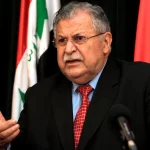
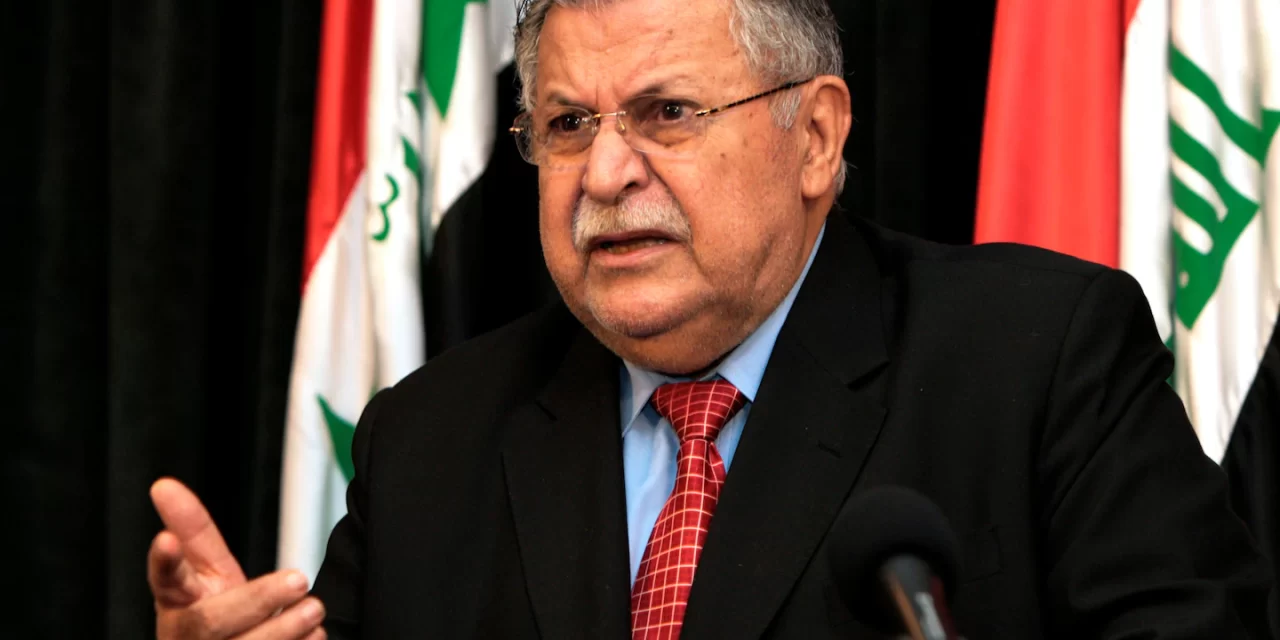
(The late Iraqi President Jalal Talabani. Photo: Ali Al-Saad/Reuters)
As a federal parliamentary republic, one of the main pillars of Iraq’s political system is the executive authority, which is comprised of two principal institutions: the presidency and the Council of Ministers. In such a system, the president typically holds protocol powers—what some jurists describe as a “signature machine”. While this may be the perceived case in Iraq, the process of electing the president and certain associated powers carry significance that can be leveraged to advance Kurdish demands.
Constitutional Powers and Limitations
The presidential position fundamentally encompasses a set of protocol powers, including the approval of parliamentary laws. According to Article 73(3) of the Constitution, if the president does not express approval within 15 days of receiving a law, it is automatically considered approved and proceeds through its legal course. Nevertheless, the president retains the authority to propose amendments to draft laws and return them to parliament for further discussion, essentially a non-binding veto on parliamentary legislation.
During the era of the Presidential Council, established after the first Iraqi parliamentary elections in 2005 for a single term, the council consisted of a president and two deputies who possessed the right to veto parliamentary laws. This arrangement was intended as a temporary measure until the Federation Council, or upper (legislative) house, could be established. Since the Presidential Council’s term expired in 2010 and the council was dissolved, the Federation Council remains to be established, leaving a significant gap in Iraq’s legislative process.
Why the Kurds Value the Presidency
Given the ceremonial nature of the position, why do the Kurds prioritize it and engage in intense political struggle over it, both at the regional and federal level? Because maintaining Kurdish control of the presidency carries substantial importance, particularly when advancing the constitutional demands and claims of the Kurdistan region within Iraq’s political process. Beyond political considerations, the presidency offers considerable material and economic privileges that primarily benefits the party that holds office. For instance, the president’s salary and allowances are determined by law (Article 74 of the Constitution), though the exact amount remains undisclosed. Additionally, the military forces designated to protect the president are estimated at several brigades. In recent years, this position has been instrumentalized to settle internal disputes within the Kurdistan region, all serving the specific partisan interests of the Patriotic Union of Kurdistan (PUK). These substantial material and economic privileges have fueled intense competition between the PUK and its rival the Kurdistan Democratic Party (KDP) over three presidential terms.
Missed Opportunities for Constitutional Demands
With the exception of Jalal Talabani’s tenure, the Kurdish parties have consistently failed to leverage the presidential position to advance their constitutional demands during the formation of Iraqi government cabinets. This failure stems primarily from Kurdish forces prioritizing personal demands in the election and government formation processes.
When the KDP and PUK impose personal demands, they forfeit the opportunity to advance political demands. Consequently, the Kurds cannot tie the conditions for electing the president and forming the government to meeting their demands—such as implementing Article 140 of the Constitution, resolving the Kurdistan region’s share of the federal budget, securing privileges for Peshmerga forces, and passing an oil and gas law. When all demands are channeled into changing the personnel of leadership positions, then political demands become impossible to impose as criteria for supporting candidates.
Strategic Importance of the Presidency
If the presidential position can be separated from personal and partisan interests, it holds tremendous importance for the Kurds. The presidency serves as the key to opening Iraq’s political process following elections. Kurdish demands in the formation of the Iraqi government can be aligned with the election of the president and the designation of the prime minister. Critically, without electing the president, which requires two-thirds of parliament’s votes, the prime minister cannot be assigned to form his or her cabinet, and consequently, no new government can be established.
Other Iraqi parties cannot elect the president and form a new government without Kurdish participation. While Kurdish parties do not control one-third of the seats in parliament to prevent quorum, past experience demonstrates that they can readily form alliances with other parties to halt the presidential election process. Therefore, Kurdish parties can prevent both the election of the president and the formation of a new government in Iraq unless their demands are incorporated into the government’s agenda.
The presidency represents principal participation in Iraq’s governance structure as one of three important leadership positions. Moreover, the president can play a crucial role in resolving constitutional disputes between regions, governorates, the central government, and the various authorities within Iraq’s political system, as the presidency is designated the “guardian of the Constitution” in Article 67 of Iraq’s Constitution. This provides constitutional reassurance for Kurdish rights, particularly regarding the Kurdistan region’s constitutional rights and the implementation of administrative, political, and financial decentralization.
Sirwan Burhan Hama Hussein
Sirwan Burhan Hama Hussein is a journalist and fellow at the Mediterranean Institute for Regional Studies.